
MIDI remains central to electronic music, but software plugins also provide their own host-accessible parameter systems. Direct Plugin Parameter Control is a proposed name for controlling those parameters through the plugin format itself rather than mapping every movement through MIDI.
Introduction
Most musicians are familiar with MIDI. Since the early 1980s, it has provided a shared language for keyboards, synthesizers, controllers, computers and other musical devices. It remains one of the foundations of modern studios and live setups.
Software plugins introduced an additional control path. A host can ask a plugin which parameters it makes available, display those parameters and send new values back through the plugin format’s own API. This makes it possible to control a filter, delay time, modulation depth or other exposed parameter without first assigning it to a MIDI CC number.
This article uses the term Direct Plugin Parameter Control, or DPPC, for that approach. DPPC is not an official VST3® term or a new plugin specification. It is a descriptive name for direct interaction with the parameter model that a plugin exposes to its host.
DPPC does not replace MIDI. MIDI remains highly effective for notes, performance data, external hardware and communication between different devices. Direct parameter access addresses a more specific problem: controlling software-plugin parameters from within a host environment.
What Is Direct Plugin Parameter Control?
Direct Plugin Parameter Control describes a host or controller application discovering and changing parameters through a plugin format’s host-facing parameter API.
Instead of sending a generic MIDI message and relying on an existing mapping, the controller addresses an exported parameter by its identifier. For example, it can change the parameter that the plugin identifies as filter cutoff, reverb size or feedback.
The important word is exported. A plugin may contain many internal DSP values and private controls that it does not make available to the host. DPPC can only reach the parameters that the developer has chosen to expose and that the host is permitted to change.
A parameter changed from the plugin interface, host automation or an external controller may ultimately affect the same exposed value. The communication path is not always identical, but the destination can be the same host-accessible parameter.
DPPC is a descriptive term
DPPC is the name used in this article for an existing host-to-plugin control model. It is not a separate protocol, certification or extension to VST3. VST3, Audio Units, CLAP and other plugin formats each provide their own parameter APIs. DPPC describes the broader control principle they make possible.
Plugins Already Work With Parameters
Most plugin interfaces are built around parameters and state. A knob may represent filter frequency, a switch may enable an oscillator and an XY pad may change several values together. The graphical interface gives the musician a practical way to interact with those functions.
The visible control is not necessarily identical to the parameter model seen by the host. One graphical control can affect several DSP values, while some host parameters may not appear on the main plugin page at all. Other functions may remain private to the plugin and never be exposed externally.
A host therefore does not receive unrestricted access to the plugin’s internal processing. It receives a defined list of exported parameters, together with information the plugin supplies about those parameters. Direct parameter control works within that published interface.
Why MIDI 1.0 Was Not Designed Around Plugin Parameters
MIDI 1.0 was introduced in 1983 to let electronic instruments from different manufacturers communicate. Its priorities included notes, velocity, pitch bend, program changes, synchronization and a manageable set of controller messages. Software plugins and large parameter lists were not part of that original design problem.
Modern plugins can expose hundreds of adjustable values. Complex synthesizers, sampled instruments, modular environments and advanced effects may provide far more controls than can be represented conveniently through a small set of conventional MIDI CC assignments.
This does not make MIDI unsuitable for music production. It means that a protocol created for communication between musical devices is not always the most direct way to address the parameter model of software already running inside a host.
DPPC avoids the MIDI-mapping stage by working with the parameter identifiers and values supplied by the plugin itself.
Plugin Parameters Are Not MIDI Messages
A MIDI message and a plugin parameter are different kinds of object.
MIDI is a communication protocol. A MIDI CC message contains a controller number and a value. What that message changes depends on the receiving instrument, plugin, DAW or mapping system.
A plugin parameter belongs to the plugin’s host-facing software model. It has an identifier and may also provide a name, default value, range information, step count, unit and automation properties. The plugin decides which parameters it exposes and how their normalized values relate to its internal DSP.
MIDI can be mapped to these parameters, but there is no universal one-to-one relationship. The same MIDI CC may control different functions in different plugins. Many plugin parameters have no MIDI assignment until the user or developer creates one.
This is why two plugins that perform similar tasks can respond very differently to the same hardware controller. The MIDI messages may be identical, while the mappings and exposed parameter structures are not.
Understanding the VST3 Parameter API
VST3 provides a standardized interface through which a plugin can publish parameters to its host. When the host loads the plugin, it can request the number of exported parameters and retrieve information about each one.
This information can include:
- A stable parameter identifier
- A title and shorter display title
- A unit or grouping
- A default normalized value
- A step count for discrete parameters
- Flags indicating whether a parameter is automatable, read-only, hidden or used for bypass
Parameter values are transferred through the VST3 interface as normalized floating-point values between 0 and 1. The plugin is responsible for translating that normalized position into a meaningful value such as hertz, decibels, milliseconds or a menu choice.
Because plugins use the same host-facing API, a VST3 host can discover and control parameters without custom programming for every manufacturer. The host does not need to understand the DSP meaning of each value. It needs the parameter identifier, the metadata supplied by the plugin and a valid method for sending changes.
High-Resolution Parameter Control
Traditional MIDI 1.0 Continuous Controller messages usually use 7-bit values, giving 128 possible positions from 0 to 127. MIDI 1.0 also supports higher-resolution techniques, including paired 14-bit controllers, and MIDI 2.0 provides much higher resolution. These options are not equally available in every controller, plugin or workflow.
VST3 parameter values are transmitted as normalized 64-bit floating-point numbers. A continuous parameter therefore does not have to be reduced to 128 MIDI CC positions before it reaches the plugin. This can provide smoother control for subtle filter changes, spectral processing, granular parameters, dynamics or other settings where small differences matter.
The transport format does not guarantee unlimited audible resolution. A plugin may expose a stepped parameter, round values internally, apply smoothing or update its DSP at a particular rate. The effective result depends on the parameter and the plugin implementation.
The accurate claim is therefore not that DPPC is always more precise than every form of MIDI. It is that direct parameter access avoids imposing the resolution of a typical 7-bit MIDI 1.0 CC on a continuous host-accessible parameter.
Why Direct Parameter Control Matters
Higher numerical resolution is only one part of the benefit. Direct parameter control also changes how controller software discovers, presents and stores assignments.
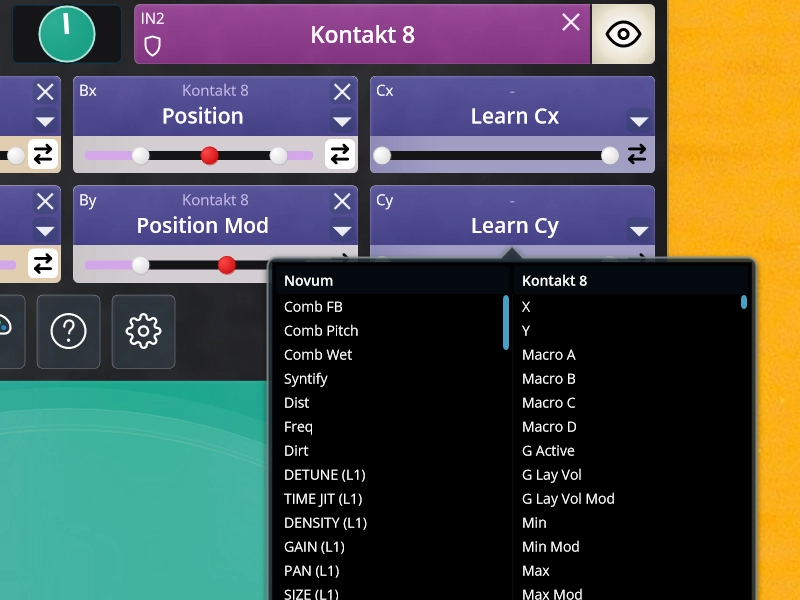
The controller can use the parameter list supplied by the plugin instead of depending on a MIDI implementation created separately by the plugin developer. Writable parameters can be presented by name, selected from a list and associated with controls without first choosing CC numbers.
This can make the workflow more consistent across very different instruments and effects. A synthesizer, reverb and dynamics processor may expose completely different parameters, but the host accesses each list through the same plugin-format interface.
Direct access does not make every plugin function available automatically. The result still depends on which parameters the developer exposes, whether they are writable and how clearly they are named. The user may also need to choose which parameters belong on the control surface.
DPPC vs MIDI Learn
MIDI Learn connects an incoming MIDI control to a function in a plugin or DAW. The user typically activates Learn, moves a hardware control and then selects or moves the destination parameter. The receiving software stores the relationship.
This remains a practical solution, especially for hardware controllers. Its behavior varies, however. MIDI Learn may be implemented by the plugin, by the DAW or by a separate mapping layer. Available options, value ranges and project recall can differ between systems.
With direct parameter access, the controller already has the parameter identifiers supplied by the plugin. It can present those parameters directly and store assignments within its own environment. No MIDI CC number is required between the controller software and the hosted plugin.
The two approaches can also be combined. A physical MIDI controller can control software that then addresses plugin parameters directly. MIDI handles the hardware connection, while the controller application handles the plugin-facing parameter assignment.
DPPC vs Automation
DPPC and automation both change plugin parameters, but they describe different parts of the workflow.
Direct parameter control describes how a controller reaches a host-accessible parameter. Automation describes how a host records, edits and plays parameter changes over time.
A performer can move a parameter through DPPC while the DAW records the resulting gesture as automation. During playback, the host sends values back to the same parameter through the plugin’s automation system.
VST3 allows parameter changes to include positions within an audio-processing block, making highly accurate automation possible. The final timing and smoothing still depend on the DAW and plugin implementation. It is therefore better to say that VST3 supports high-precision automation than to promise that every plugin reproduces every parameter sample by sample.
DPPC and automation are complementary. One provides live access. The other stores and reproduces the movement.
DPPC vs Macros
A macro links several parameters to one control. It reduces a complex set of changes to a simpler performance gesture. A plugin may provide its own macros, or a DAW and controller environment may create them externally.
Direct parameter access works at the level of the parameters exposed by the plugin. Controller software can use those parameters individually or combine them into new macros, ranges and multidimensional controls.
DPPC does not need to bypass macros. A controller can address an exported macro parameter when that is the most useful target. It can also build a different relationship from the underlying parameters when those parameters are available separately.
Macros and direct access therefore serve different roles. One defines a relationship between controls. The other provides a way to reach the available parameter destinations.
DPPC vs OSC
Open Sound Control is a flexible protocol for sending structured messages between applications and devices. It supports network communication, descriptive address patterns and numerical values with greater flexibility than traditional MIDI 1.0 CC messages.
OSC is still a transport and messaging system. Sending a message such as /filter/cutoff does not automatically tell the receiving application which VST3 parameter should change. The receiving software must understand the address and connect it to the correct destination.
DPPC describes the plugin-facing side of that relationship. The host or controller uses the parameter model exposed by the plugin to identify and change the destination.
The two concepts are not competitors. An application can receive OSC from a tablet or another computer and then use direct parameter access to change a plugin. OSC transports the instruction between applications. The plugin API provides access to the parameter.
VST2 and VST3 Parameter Handling
Direct host control of plugin parameters did not begin with VST3. VST2 already allowed hosts to read and write parameter values. Many hosts used that capability for generic editors, automation and controller integration.
VST3 developed the model further. It introduced richer parameter metadata, stable identifiers, clearer flags, normalized value conversion, improved organization and a more explicit separation between editing and audio processing.
This richer description is particularly useful for software that needs to discover parameters, display them clearly and manage assignments across many different plugins.
VST3 does not reveal the complete internal architecture of a plugin. It provides a standardized view of the parameters the plugin has chosen to publish to the host. That distinction should remain clear throughout the article.
What About Audio Units and CLAP?
The principle behind DPPC is not limited to VST3. Other plugin formats also define ways for a host to discover and change parameters directly.
Apple’s Audio Unit architecture provides host-accessible parameter structures for Audio Unit plugins. CLAP defines a parameter extension through which hosts can retrieve parameter information, read values and send parameter changes and gestures.
The details differ between formats. Identifiers, metadata, event handling and automation capabilities are not identical. The shared principle is that the host communicates with a parameter model defined by the plugin format rather than relying entirely on MIDI mapping.
DPPC should therefore be understood as a general control concept. VST3 is the format used by TouchMod, but the idea of direct host-to-plugin parameter access is broader than VST3.
Why Touch Controllers Benefit From DPPC
A physical controller has a fixed collection of knobs, faders, pads and buttons. A touchscreen can change its layout for each plugin, project or performance. Direct parameter discovery makes that adaptability much easier to use.
The controller can retrieve parameter names and identifiers from the loaded plugin, let the user choose the relevant destinations and build a surface around the current task. A delay may need feedback, filtering and Wet/Dry balance. A synthesizer may need cutoff, resonance, wavetable position and modulation depth.
Direct access does not remove the need for thoughtful assignment. A plugin with hundreds of parameters still requires decisions about which controls belong together and what ranges are musically useful. The advantage is that these choices can be made without creating an intermediate MIDI map for every plugin.
Touch also supports forms of interaction that are difficult to reproduce with a row of independent knobs. Several parameters can move together, two dimensions can be controlled with one finger and gestures can be recorded or transformed. These possibilities come from combining a flexible interface with direct access to the plugin’s exposed parameters.
TouchMod uses this model to control VST3 instruments and effects. It is one application of the broader DPPC concept, not the definition of the concept itself.
Frequently Asked Questions
Is DPPC an official plugin standard?
No. Direct Plugin Parameter Control is a descriptive term proposed in this article. It refers to the use of a plugin format’s parameter API for direct host or controller access. It is not a separate protocol, VST3 extension or certification.
Does DPPC replace MIDI?
No. MIDI remains central to communication with keyboards, controllers, synthesizers and other external hardware. It is also widely used for notes, performance data and control inside software.
DPPC addresses a narrower task: allowing host or controller software to work directly with parameters exposed by a plugin. A system can use MIDI on the hardware side and direct parameter access on the plugin side.
Is DPPC more accurate than MIDI?
Compared with a typical 7-bit MIDI 1.0 CC mapping, direct access to a continuous plugin parameter can provide much finer numerical resolution.
That does not mean DPPC is more accurate than every possible MIDI implementation. MIDI 1.0 supports some 14-bit techniques, and MIDI 2.0 provides much higher-resolution controller data. The effective result also depends on the plugin’s parameter design and processing.
Does every VST3 plugin support DPPC?
VST3 defines a standard parameter interface through which plugins can publish parameters to a host. Practical access depends on what each plugin exposes.
Some parameters may be read-only, hidden, stepped or unavailable to external control. Other functions may exist only inside the plugin interface. DPPC can work with the writable host-accessible parameters that the plugin provides.
Can DPPC work with effects as well as instruments?
Yes. The concept applies to instruments, effects, mastering processors and utility plugins. The important condition is not the type of plugin, but whether it exposes useful writable parameters to the host.
The Future of Plugin Control
MIDI solved the problem of communication between electronic instruments with remarkable durability. More than four decades later, it remains essential because hardware, software and performance systems still need a shared musical language.
Software plugins add another layer. They expose structured parameter models to their hosts, allowing controllers and DAWs to address software functions without translating every movement through a conventional MIDI CC assignment.
As plugins become more complex, the challenge is no longer simply gaining access to more parameters. It is deciding which parameters matter, how they should be grouped and how a musician can move them in a meaningful way. Direct parameter access provides the technical foundation, but good control design remains a musical and ergonomic problem.
The term DPPC may or may not become widely adopted. The underlying approach is already established in modern plugin hosting: discover the parameters a plugin exposes, address them through the plugin API and combine that access with automation, MIDI, OSC, hardware or touch according to the needs of the workflow.
Seen this way, DPPC is not a campaign against MIDI. It is a useful name for another part of the control chain, one that becomes increasingly visible when software itself is treated as a playable instrument.